
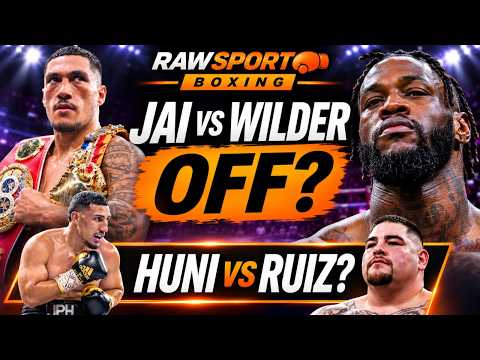
Uncertainty over Jai Opetaia’s proposed fight with Deontay Wilder opened a broader argument on Raw Sport: how should Australia’s leading boxers balance major opportunities with the fights that will develop them? Ahmad Elhawli, Nedal Hussein and Nathan Di Carlo examined the reported fallout before debating Teremoana’s progression, a possible Justis Huni–Andy Ruiz Jr. match-up and the recognition owed to Jason Moloney.
The panel discussed reports that Opetaia’s meeting with Wilder would not proceed, but the reasons remained unsettled. Hussein said he had heard the contract had not been signed on Opetaia’s side. Di Carlo had heard suggestions of contractual and financial problems, while acknowledging he did not know whether those accounts were accurate. Those explanations were presented as information the panellists had heard, rather than an established account from the parties involved.
Elhawli questioned why major fights are promoted before agreements are finalised. For him, the uncertainty raised questions about the process behind an announcement and the expectations it creates for fans. Di Carlo broadened that concern to the speed at which rumours spread through boxing coverage. The discussion repeatedly returned to the distance between a proposed contest, its public promotion and a signed agreement.
On the hypothetical fight itself, Di Carlo favoured Opetaia’s movement and boxing ability against Wilder. Hussein maintained that the heavyweight’s power would still give him a chance. Their disagreement captured the central risk: an Australian boxer might appear technically superior while still facing an opponent capable of changing a fight with one punch. Di Carlo also rejected a viewer’s suggestion that Opetaia was avoiding challenges, pointing to his willingness to test himself.
Teremoana’s development produced an equally pointed exchange. Previewing his fight with Hemi Ahio, Hussein viewed the opponent as a useful step up and expected the contest to last several rounds. Di Carlo predicted an earlier finish, arguing that Teremoana’s punching power could be decisive. Yet confidence in that power did not settle the question of when he would be ready for a world-title challenge.
Hussein wanted to see Teremoana go rounds, lose rounds and respond to resistance before making that assessment. He argued that Australia already had heavyweights who could provide meaningful tests. Di Carlo also supported using domestic opposition and said the value of a development programme depended on the rounds banked, rather than simply reaching a particular number of professional fights. Their debate separated enthusiasm about potential from evidence gathered in demanding contests.
The possible Huni–Ruiz fight offered another version of that matchmaking question. Hussein liked Ruiz’s quick hands and the entertainment he could bring, while Di Carlo saw a contest that could suit Huni. Both treated the pairing as a possibility under discussion. Looking back at Huni’s loss to Fabio Wardley, the conversation centred on how quickly a strong boxing performance can unravel in the heavyweight division, reinforcing the distinction between winning rounds and securing the result.
The tone shifted when the panel reviewed Moloney’s performance. Hussein praised the willingness of Jason and Andrew Moloney to fight overseas and take difficult assignments. Di Carlo highlighted Jason’s sharpness, footwork and professionalism. Elhawli asked why those qualities had not translated into greater recognition at home, prompting a discussion about the visibility of lighter-weight boxers and the trade-off between overseas opportunities and a regular Australian presence.
Across those conversations, the panel’s recurring concern was what sits behind a boxer’s next opportunity: contractual certainty, suitable opposition, experience under pressure and public recognition. Opetaia’s uncertain plans supplied the opening, but the debate reached well beyond one proposed fight. Watch the full Raw Sport episode below for the panel’s analysis and exchanges with viewers.