
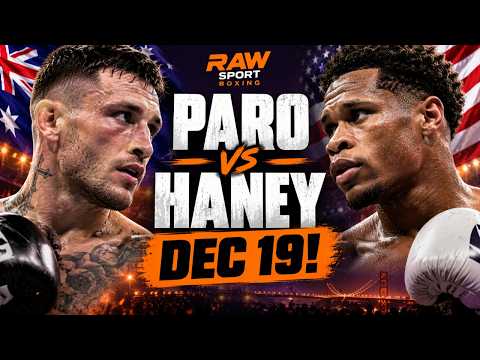
Liam Paro must turn pressure into sustained work on the inside if he is to unsettle Devin Haney, according to Nedal “Skinny” Hussein and Nathan Di Carlo. On Raw Sport, the pair agreed that closing the distance is central to the Australian’s chances, but differed on whether he could win a tactical contest on the scorecards.
Joining host Ahmad Elhawli, Hussein and Di Carlo examined the reported December 19 matchup through a practical question: how does Paro get past Haney’s jab without allowing the American to dictate the exchanges? Their discussion placed timing, concentration and ring positioning ahead of any confidence drawn from past sparring.
Hussein warned against reading too much into gym encounters. Fighters can arrive at sparring at different weights, in different condition or simply have an off day, he explained. He regarded Haney as an exceptionally difficult opponent whose ability to manage distance could leave Paro facing a frustrating night.
For Hussein, the jab is more than a scoring punch. It helps Haney establish the range for his right hand and left hook. Paro therefore needs to disrupt the sequence rather than accept the first shot and wait for the next. “He has to get on the inside,” Hussein said. Once there, Paro would still need to work before Haney could tie him up and force a reset.
Di Carlo also praised Haney’s jab, while stressing the importance of moving off the centre line. He considered Paro’s southpaw stance an advantage, though one that an experienced opponent would be equipped to handle. The task, in his view, is to combine that stance with a deliberate plan for reaching punching distance.
Both guests returned to Paro’s experience against Richardson Hitchins. Hussein’s concern was that Paro could surrender rounds while searching for answers, allowing a skilled boxer to grow in confidence. He emphasised maintaining focus and following the corner’s instructions even when the action becomes frustrating.
Di Carlo saw grounds for greater optimism in Paro’s ability to execute different game plans. He argued that the Australian did not necessarily need to reproduce Ryan Garcia’s power to trouble Haney: clean punches and accumulated points could provide another route. Hussein disagreed on the likely winning method, believing Paro would need a stoppage because Haney is so adept at controlling the pace and finding rounds.
The conversation then turned to Nikita Tszyu’s planned American debut and the balance between opportunity and development. Hussein favoured revisiting the Ben Mahoney fight before moving on. Di Carlo understood that approach, but argued that an international opportunity on a major card could be difficult to pass up, particularly without knowing the circumstances behind the matchmaking.
On Tszyu’s defence, their views converged. Both questioned how long an approach built around absorbing punches to deliver more could remain effective as the opposition improves. Di Carlo favoured gradual technical changes, beginning with softer footwork, stance adjustments and small movements that reduce the force of incoming shots. “His feet have to do his defensive work for him,” he said.
Hussein likewise identified Tszyu’s heavy base as both a source of power and a defensive limitation. The discussion exposed a difficult development problem: preserving the attacking qualities that make Tszyu compelling while helping him leave exchanges more safely. Neither guest treated entertainment value alone as proof of readiness for the highest level.
That tension between talent, audience appeal and meaningful competition also shaped the discussion of Shakur Stevenson. Di Carlo wanted to see Stevenson back in the ring against strong opposition, placing that above the identity of his promoter. Across the episode, the recurring demand was for progress that can be tested in the ring: a workable plan for Paro, defensive improvement for Tszyu and competitive activity for Stevenson.